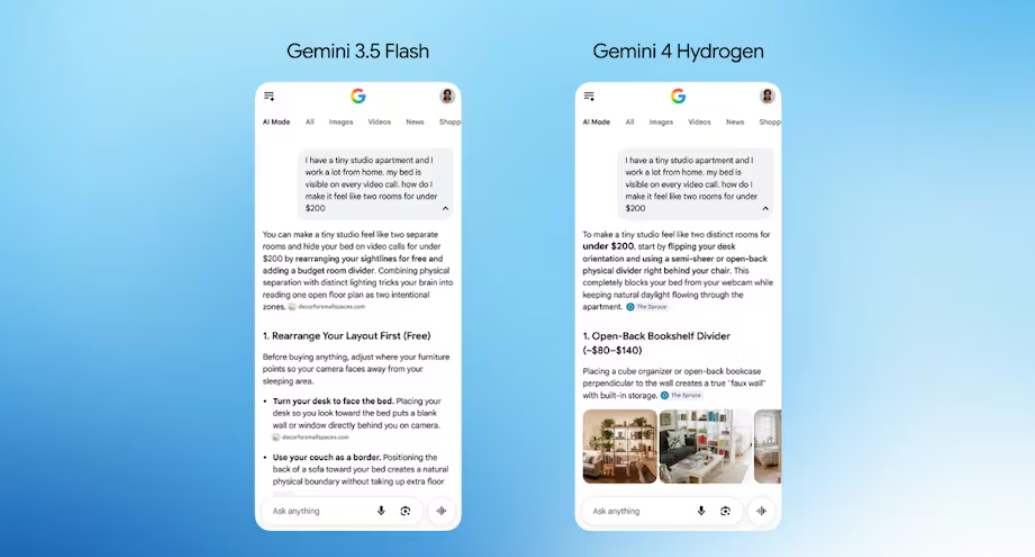
On Thursday, Google unveiled its latest artificial intelligence model, Gemini 4 Hydrogen, designed to provide faster AI assistance for everyday tasks. The Mountain View-based tech giant stated that, rather than being intended for extended reasoning, Gemini 4 Hydrogen focuses on coding, research, and agentic workflows that require rapid execution. Gemini 4 Hydrogen is available across Google’s developer tools, enterprise services, the Gemini app, and Search; it is also more accessible to use than the company’s other AI models.
Gemini 4 Hydrogen
In a blog post, Google describes Gemini 4 Hydrogen as a faster and more efficient model tailored for routine coding and agentic workflows. While Gemini 4 Carbon and Gemini 4 Argon are designed for complex reasoning and longer-running tasks, Hydrogen is optimized for quick execution.
According to the company, this AI model can also collaborate with other models to build multi-model workflows. It is capable of handling tasks such as writing code, running tests, and verifying changes.
Google states that, at the default “high” reasoning level, Gemini 4 Hydrogen achieves a score of 51 on the AI Analytical Intelligence Index (AII), surpassing Argon’s score of 50. At the maximum “xhigh” reasoning level, its score reaches as high as 54. The tech giant also claims that the model outperforms comparable models in terms of the speed at which it completes tasks.
A key use case for Hydrogen is reportedly multi-model collaboration. In “Google Antigravity,” Google has introduced an “Orchestrator” that moves away from relying on a single model to complete an entire task; instead, it can dynamically switch between models—such as Carbon and Hydrogen—during a session.
In Terminal-Bench 4.0 testing, Google claims that Orchestrator achieves a task success rate comparable to Carbon, while reducing average quota consumption by 24% and increasing task completion speed by 19%. In workflows involving parallel agents, Carbon coordinates tasks, while Hydrogen assumes the roles of “worker” and “verifier” agents. According to Google, this allows code to be built and tested simultaneously within isolated workspaces.
In the realm of software development, Hydrogen is designed to handle debugging, codebase navigation, troubleshooting, and iterative coding focused on specific changes. According to Google, it can examine large codebases by processing file reads and search calls in parallel. The model is also capable of performing open-ended tasks, such as in-depth research, data analysis, and navigating extensive codebases.
Gemini 4 Hydrogen supports up to 1 million input tokens and 1 million output tokens. The company states that this enables it to process vast quantities of documents, spreadsheets, charts, audio, and recorded video, ultimately generating reports and structured deliverables. The model offers four levels of “reasoning” (or “thinking”): low, medium, high, and ultra-high.
This feature is also available within the Gemini app. According to the company, this AI model is capable of following instructions more precisely, utilizing relevant tools, and handling multi-step requests with ease—all while reducing the need for back-and-forth communication. It can assist users in drafting emails, study guides, and documents, while strictly adhering to the requested tone and format.
Google claims that “Hydrogen” will enhance Google Search’s ability to understand complex queries—such as those containing multiple components, specific requirements, or even typos. Furthermore, by improving “query fan-out” technology, the AI model will generate more intuitive, easy-to-navigate search results, while also providing a broader range of relevant links.
Google has announced that the Gemini 4 Hydrogen model is being rolled out globally to developers, businesses, and consumers. Developers can access the model via the Gemini API in Google AI Studio, as well as through paid versions of Android Studio. Enterprise customers can utilize the model via Gemini for Business, Google Antigravity, and Gemini within Google Sheets (available to eligible subscribers). For consumers, the model is accessible through the model-selection menu in the Gemini app and via Google Search—a feature Google states is available to all Google Search users. Additionally, subscribers to Google AI Pro and Ultra have access to the Gemini model within Google Sheets.