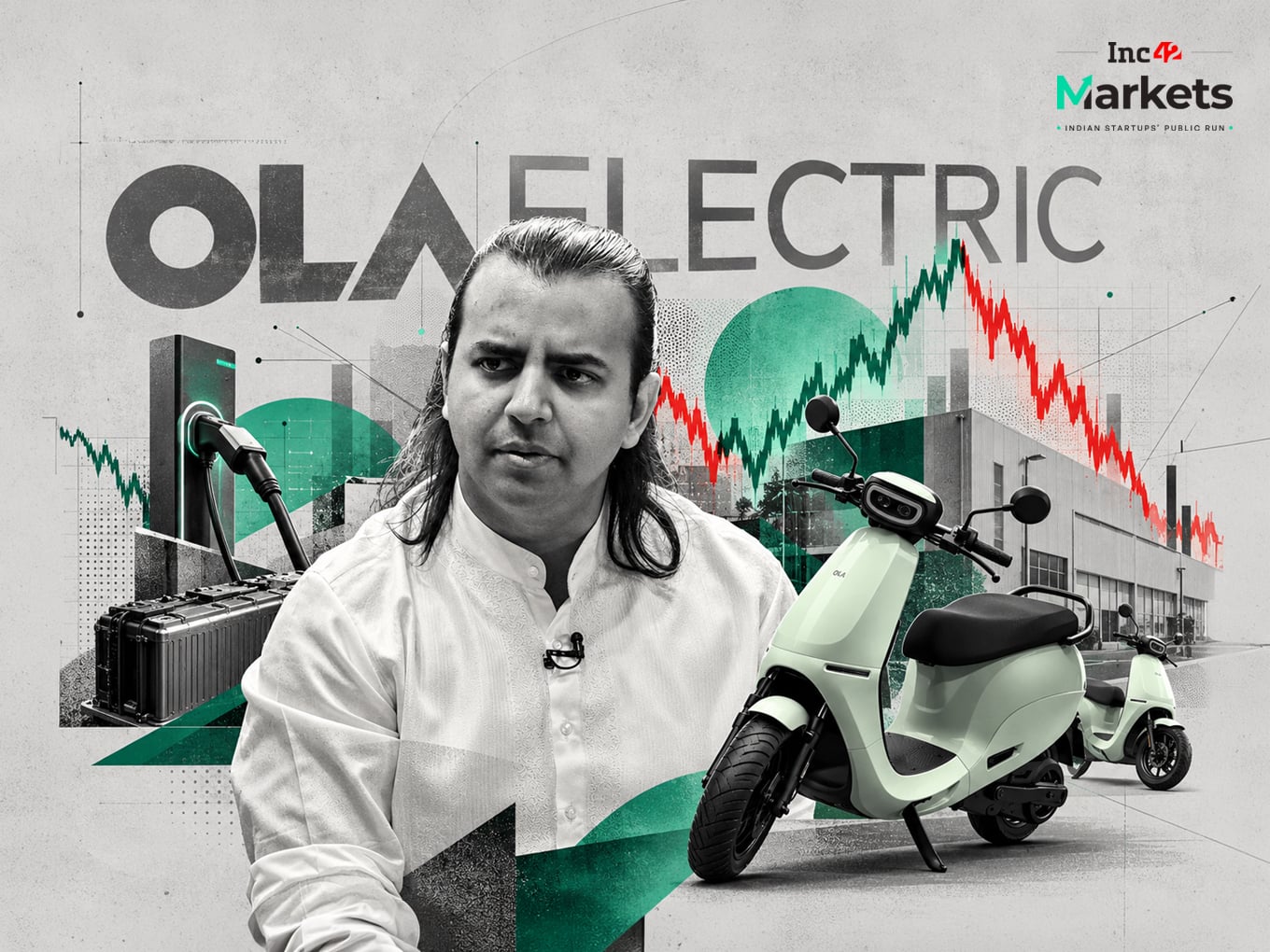
Managing a high-growth electric vehicle pioneer while retaining voting control is a tricky tightrope walk—especially when personal ventures and public entities collide.
Over the past two years, founder Bhavish Aggarwal has navigated a complex sequence of stock pledges, equity sales, and leverage maneuvers to maintain his controlling stake in Ola Electric while supporting his side ventures, including AI data center infrastructure provider Krutrim Data Centre. Here is a deep dive into the financial mechanics of this high-stakes pledge cycle, what it means for institutional investors, and why company balance sheets are feeling the heat.
1. The Financial Loop: Pledge, Unpledge, and Re-Pledge
To understand the current tension, it helps to look at the sequence of transactions over the past 24 months. Between November 2024 and March 2025, shares were pledged to secure ₹2,600 crore ($310M+) in debt for Krutrim. By December 2025, to avoid margin calls as stock prices dipped, a 3.93% equity stake was sold to eliminate debt and unencumber the remaining shares.
In September 2026, Aggarwal pledged 200 million shares (a 4.32% stake) as collateral against Non-Convertible Debentures (NCDs) issued by Krutrim Data Centre to CTL Trusteeship. Just four months after raising ₹780 crore via a Qualified Institutional Placement (QIP) in June 2026, the board approved a ₹1,000 crore rights issue.
Under Indian corporate law (Section 67(2) of the Companies Act, 2013), a public company cannot directly loan funds to a promoter to subscribe to its own rights issue. Because selling shares to fund participation would dilute Aggarwal’s ~26.2% controlling stake, pledging equity to generate capital through a separate entity became the preferred structural avenue.
2. Operational Realities vs. Cash Burn
The upcoming ₹1,000 crore rights issue allocates ₹350 crore for debt repayment and ₹400 crore for organic expansion. However, the company continues to battle operational hurdles across its balance sheet:
- Q1 FY27 Revenue: Recorded at ₹455 crore, down 45% year-over-year and missing internal guidance of ₹500–₹550 crore.
- Q1 FY27 Net Loss: Stood at ₹336 crore, marking a 7-quarter low.
- Q1 FY27 Free Cash Flow: Remained negative at approximately -₹351 crore.
- EV Market Share: Rebounded to 8.4% in Q1 FY27 from 5.1% in Q4 FY26, but remains below the company’s 15%–20% target.
- Deliveries vs. Competitors: Delivered 39,192 scooters in Q1 FY27—less than half of rival Ather’s 83,173 units—while carrying higher operational losses.
With quarterly free cash flow remaining negative at ~₹351 crore, the ₹780 crore raised in June provided roughly two quarters of operational runway, explaining the quick decision to seek additional capital via the rights issue.
3. The Governance Risk Factor
Corporate governance analysts point out that linking a public company’s equity to the debt obligations of an unlisted private venture creates structural vulnerabilities:
- Cross-Collateral Risks: If Krutrim encounters difficulty servicing its debt obligations, lenders could enforce the pledge and liquidate the 200 million Ola Electric shares in the open market.
- Cascading Downward Pressure: The stock currently trades around ₹37—less than half its ₹76 IPO price—with institutional brokerages like Citi setting 12-month target prices around ₹26. Any forced selling by lenders to fulfill margin calls risks triggering a downward price spiral.
- Investor Perception: Frequent shifts between pledging, liquidating, and re-pledging shares signal promoter balance sheet stress, weighing heavily on institutional investor sentiment.
4. Market Pulse: IPO Movements and Public Filings
Beyond the EV sector, several other major moves hit the technology and capital markets recently:
- E-Commerce Parent Debut: AceVector (parent of Snapdeal) listed on the BSE at ₹28.30—an 11.6% discount to its ₹32 IPO price—closing its first session down 18.4% at ₹26.10 with a market cap of ₹1,420 crore.
- Drone Tech Executive Pledge: ideaForge CEO Ankit Mehta pledged a 0.56% stake (worth ~₹20.56 crore) to Infina Finance for personal financial requirements, coming shortly after the company’s ₹500 crore QIP in July.
- VC Partial Exit: Peak XV sold 1.22 million shares of coworking provider Awfis at ₹245 per share via a ₹30 crore block deal, paring down more than half of its holding.
- Baby Products Unit Cleared for IPO: Brainbees Solutions (FirstCry parent) subsidiary Swara Baby Products received SEBI approval for a ₹1,000 crore public offering.
- Agri-Drone RHP Filed: AITMC submitted its final Red Herring Prospectus for an issue of up to 35 million new shares, reporting FY26 revenue of ₹106.8 crore and net profit of ₹13.4 crore.
- Fintech Confidential Filing: StockGro parent AssetGro Fintech filed a confidential DRHP for a ₹2,500 crore IPO (including a ₹800 crore primary issue) alongside securing a $10.4 million Series B round led by BITKRAFT Ventures.
Final Thoughts
Pledging shares to protect equity ownership is a common corporate playbook, but it leaves little room for operational error. For Ola Electric, the critical path ahead lies in slowing down quarterly cash burn, expanding gigafactory capacity, and proving that its core manufacturing unit can achieve profitability before funding windows narrow further.